
Shopify MCP for store reporting
Analyze sales, orders, products, customers, discounts, refunds, and acquisition from any MCP-compatible AI.


10,000+ marketers scaling with AI.
Trusted by marketing teams at












What you can do with Shopify MCP
Turn Shopify order data into clear store, product, customer, and attribution answers without rebuilding reports by hand.
Track store performance
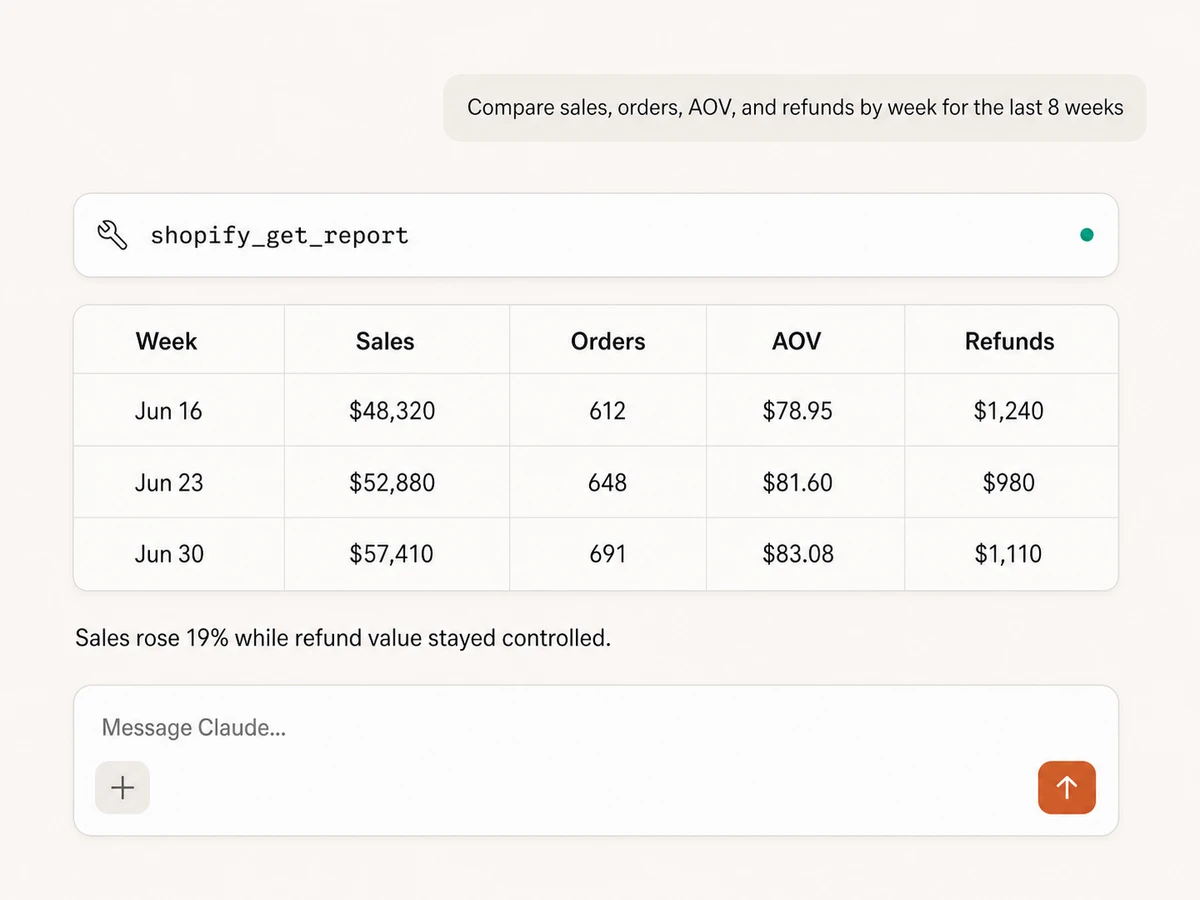
Report on sales, gross and net sales, orders, average order value, discounts, refunds, shipping, and tax across the date range you ask for.
Compare periods cleanly
Group results by day, week, or month, compare periods, sort the output, and focus the conversation on the change that matters.
Rank products and variants
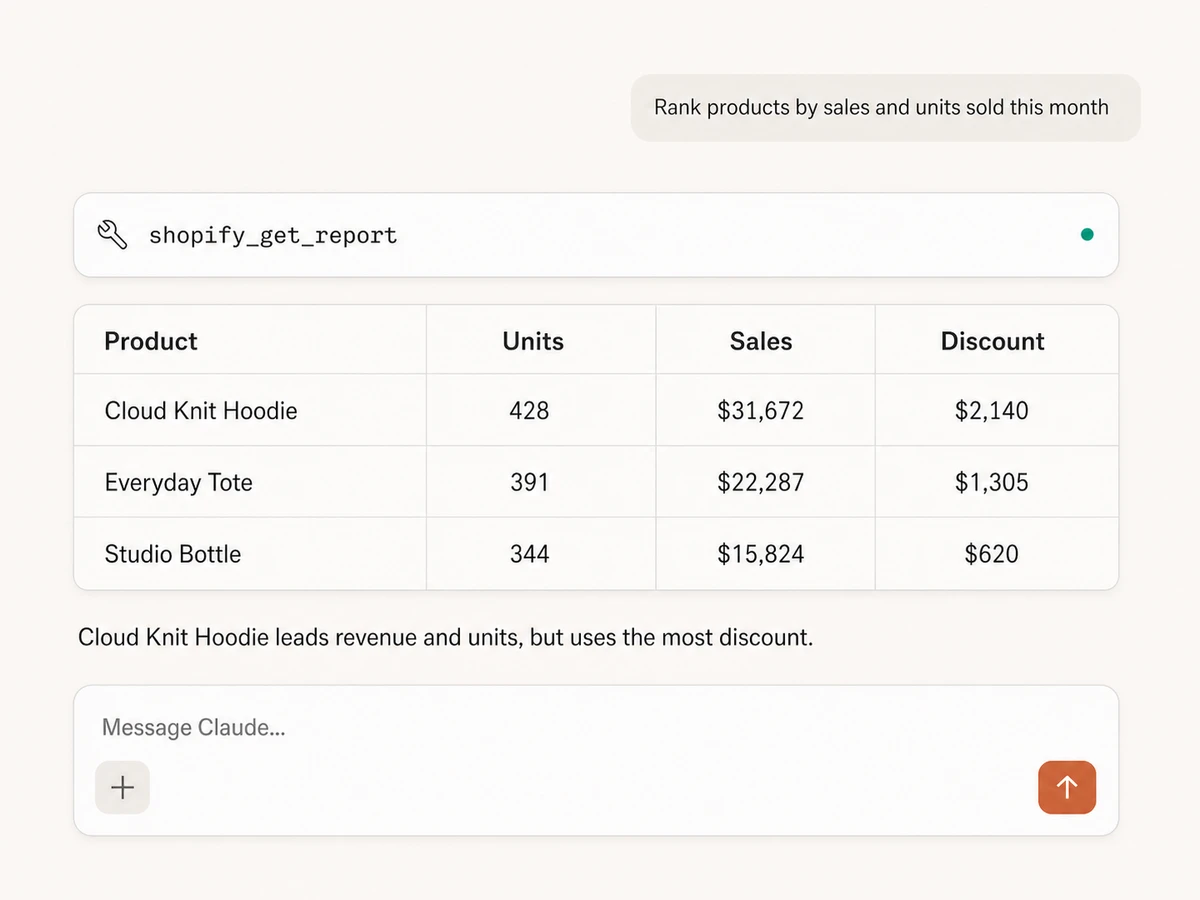
Break order data down by product, variant, SKU, vendor, quantity, sales, price, and discount to find what is driving revenue.
Use the fields Shopify can return
Search the reporting schema first, then build the exact report with supported metrics, dimensions, filters, and sorting.
Understand customer quality
Analyze new versus returning customers, customer order number, lifetime orders, lifetime spend, geography, and average order value.
Connect revenue to acquisition
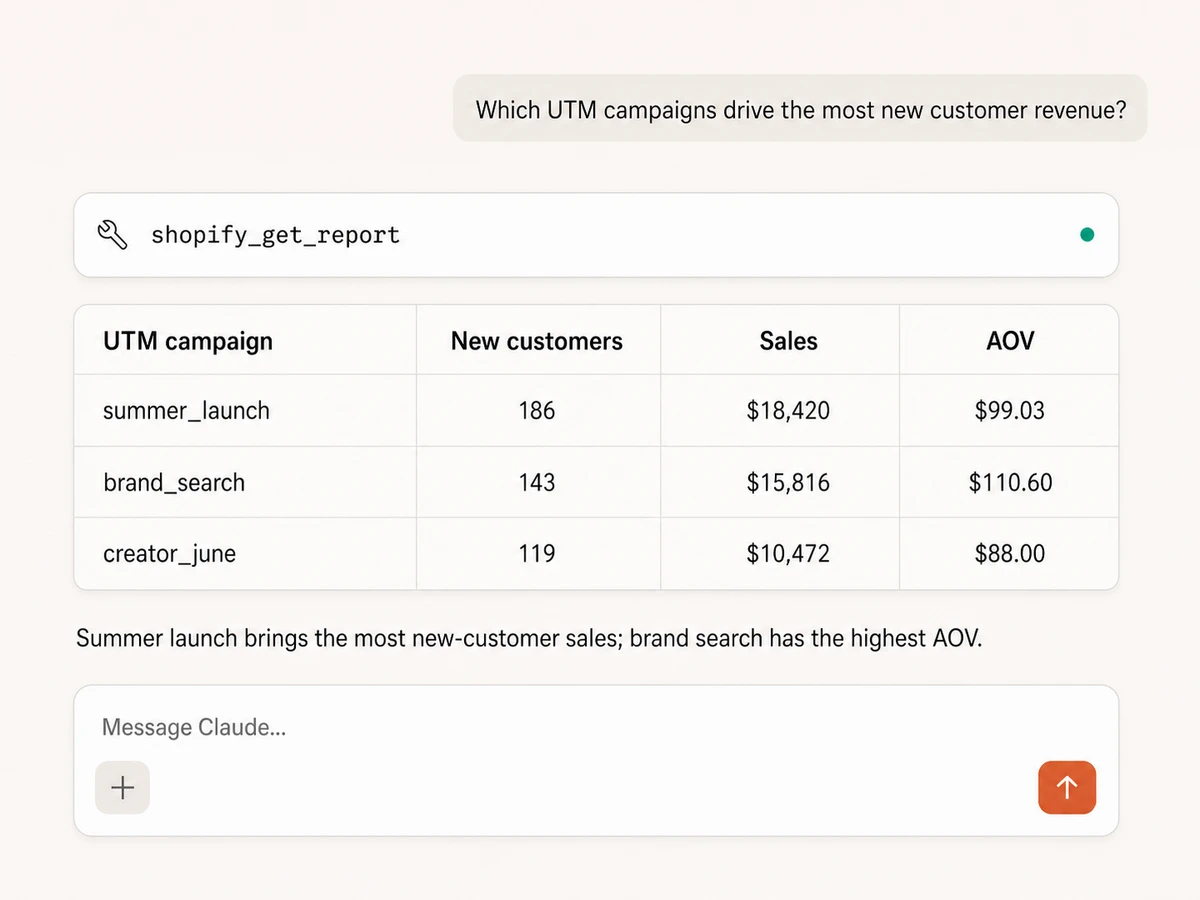
Break orders down by UTM source, medium, campaign, content, term, referring site, landing page, and order source to see where customers came from.
Use Shopify in your favorite AI.
Plus your whole marketing stack
One MCP connection brings store revenue, your marketing tools, and your preferred AI assistant into the same workflow.





























Set up in minutes
Connect Shopify, add Markifact to your AI client, and start asking store questions.
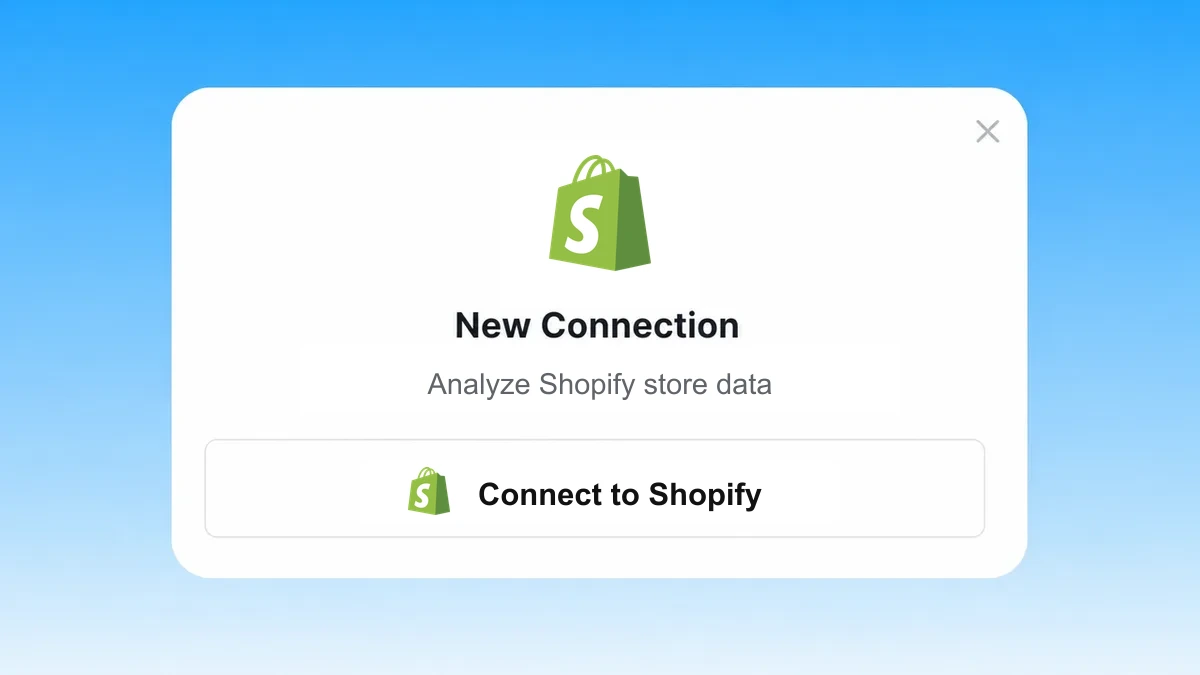
Connect Shopify
Enter your store and approve Shopify's OAuth connection. Each connection maps to one store, so your reports always use the right store context.
Markifact is available in the Claude connector directory:
Connect in Claude Open the listing and click Connect to add Markifact to Claude.
Connect your AI assistant
Pick Claude, ChatGPT, Cursor, or another MCP-compatible assistant and copy the setup. One endpoint connects it to Markifact.
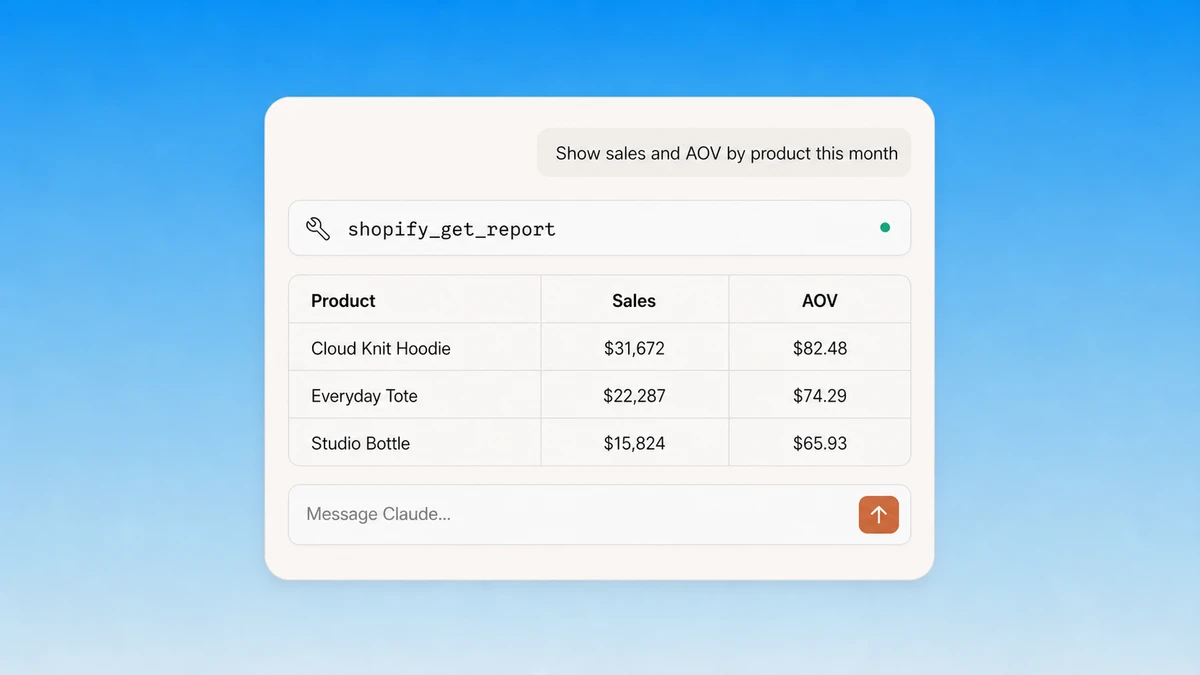
Start analyzing your store
Ask for store trends, product rankings, customer value, attribution, discounts, refunds, or order status using the dimensions that fit the question.
Shopify MCP prompt examples
Start with the commerce question. Markifact can find the right reporting fields and return a focused Shopify report.
Read the health of the store without exporting a dashboard.
- >
Compare sales, orders, AOV, discounts, and refunds by week for the last 8 weeks.
- >
Why did net sales fall last week even though order volume increased?
- >
Show paid, pending, refunded, and partially refunded orders this month.
- >
Compare web, POS, draft order, and other order sources by sales and AOV.
What a session actually looks like
One request can discover the right Shopify fields, run the report, and explain where margin pressure is coming from.
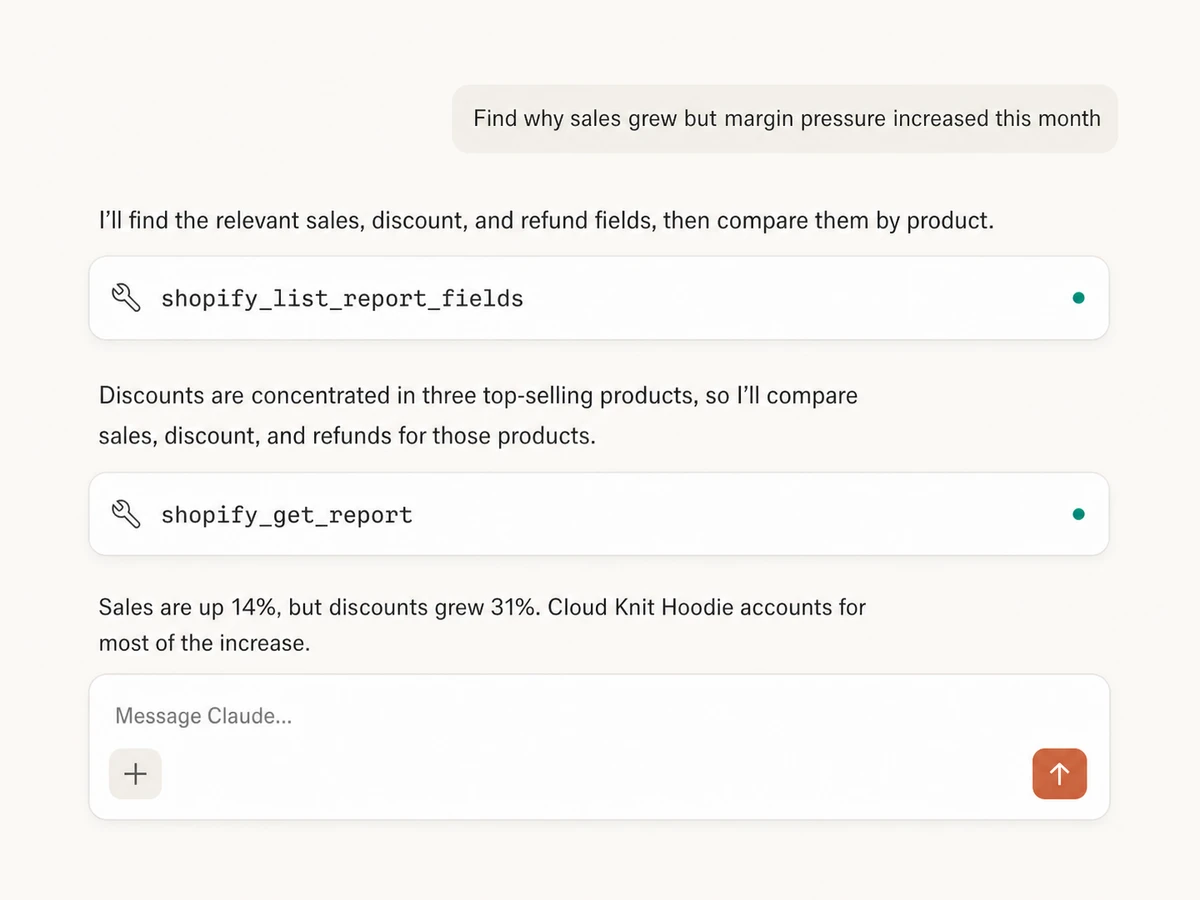
Example session using shopify_list_report_fields and shopify_get_report to explain a change in product economics.
Which Shopify MCP option is right for you?
Shopify's first-party MCP surfaces serve shoppers and developers. Markifact serves commerce and marketing teams that need store reporting across the wider stack.
Shopify first-party MCPs
Storefront shopping and developer help
Choose it if
- Your agent helps shoppers search a catalog, manage a cart, check out, or retrieve an eligible order
- You want Shopify development docs, schema inspection, and code guidance through the Dev MCP
Direct Admin GraphQL API
Maximum control for a custom product
Choose it if
- Your engineering team needs custom Shopify reads or mutations
- You can own app setup, scopes, API versions, aggregation, limits, and maintenance
Markifact
Hosted Shopify reporting across your stack
Choose it if
- You want sales, product, customer, and attribution answers without query plumbing
- You need Shopify revenue beside paid media, analytics, email, and warehouse data
- You want one hosted MCP connection for the wider marketing workflow
| Capability | Markifact | Shopify first-party MCPs | Direct Admin API |
|---|---|---|---|
| Primary job | Merchant sales, product, customer, and attribution reporting | Buyer-facing catalog search, product lookup, cart, checkout, and eligible order state | Build any permitted merchant workflow yourself |
| Setup | Connect a store with OAuth, then use one hosted MCP endpoint | Store-domain UCP MCP endpoint with agent capability and authentication rules | Create an app, configure scopes, authentication, queries, and hosting |
| Store analytics | Flexible reports with metrics, dimensions, filters, sorting, and date comparisons | Not designed as a merchant analytics surface | Available when you design the queries and aggregation layer |
| Product reporting | Product, variant, SKU, vendor, quantity, sales, price, and discount from order data | Search and retrieve storefront product details and availability | Full API data allowed by the app scopes |
| Customer reporting | New and returning customers, lifetime orders, lifetime spend, and geography | Buyer context, not a merchant customer report | Available with the required protected-customer-data access |
| Attribution | UTM source, medium, campaign, content, term, landing site, and referring site | Not its purpose | You build attribution logic from order and journey fields |
| Write actions | Read-only for Shopify today | Buyer shopping actions within supported UCP capabilities | Mutations are possible when scopes and Shopify rules allow them |
| Cross-stack analysis | Shopify beside ads, analytics, Klaviyo, Sheets, BigQuery, and Slack | Shopify storefront experience | Every additional platform is another integration to build |
| Maintenance | Hosting, schemas, OAuth, and reporting logic handled | First-party surfaces operated by Shopify | Your team owns API versions, limits, auth, infrastructure, and data modeling |
| Best fit | Commerce and marketing teams asking performance questions | AI shopping agents serving buyers | Engineering teams building custom commerce products |
More MCP servers
All MCP serversKlaviyo MCP
Use Klaviyo inside MCP clients for flow and campaign reporting, revenue diagnosis, and owned-vs-paid comparison across your funnel.
Google Merchant Center MCP
Use Merchant Center inside MCP clients for product reporting, diagnostics, data sources, catalog updates, inventory, promotions, and approval-based writes.
Google Analytics MCP
Query GA4 from MCP clients with custom reports, property audits, and traffic diagnosis, then configure the property and act on findings in your ad platforms with approval-gated writes.
BigQuery MCP
Use BigQuery inside MCP clients to explore schemas, run SQL, create datasets and tables, insert rows, and approve every write.
Frequently Asked Questions
Have a different question? Reach out to Markifact support team.
Turn Shopify data into clear answers
Connect Shopify and analyze store, product, customer, and acquisition performance from any MCP-compatible client.