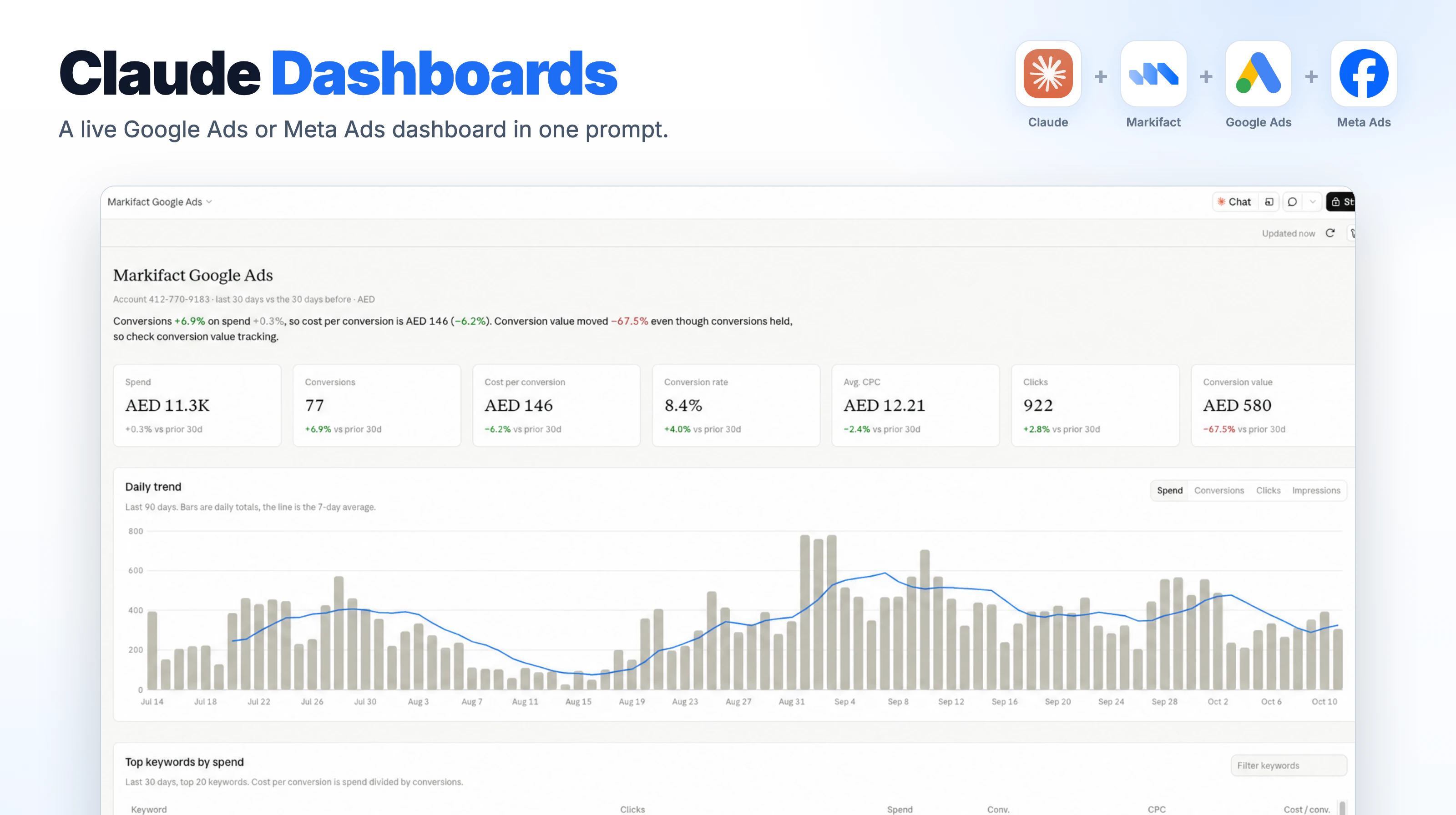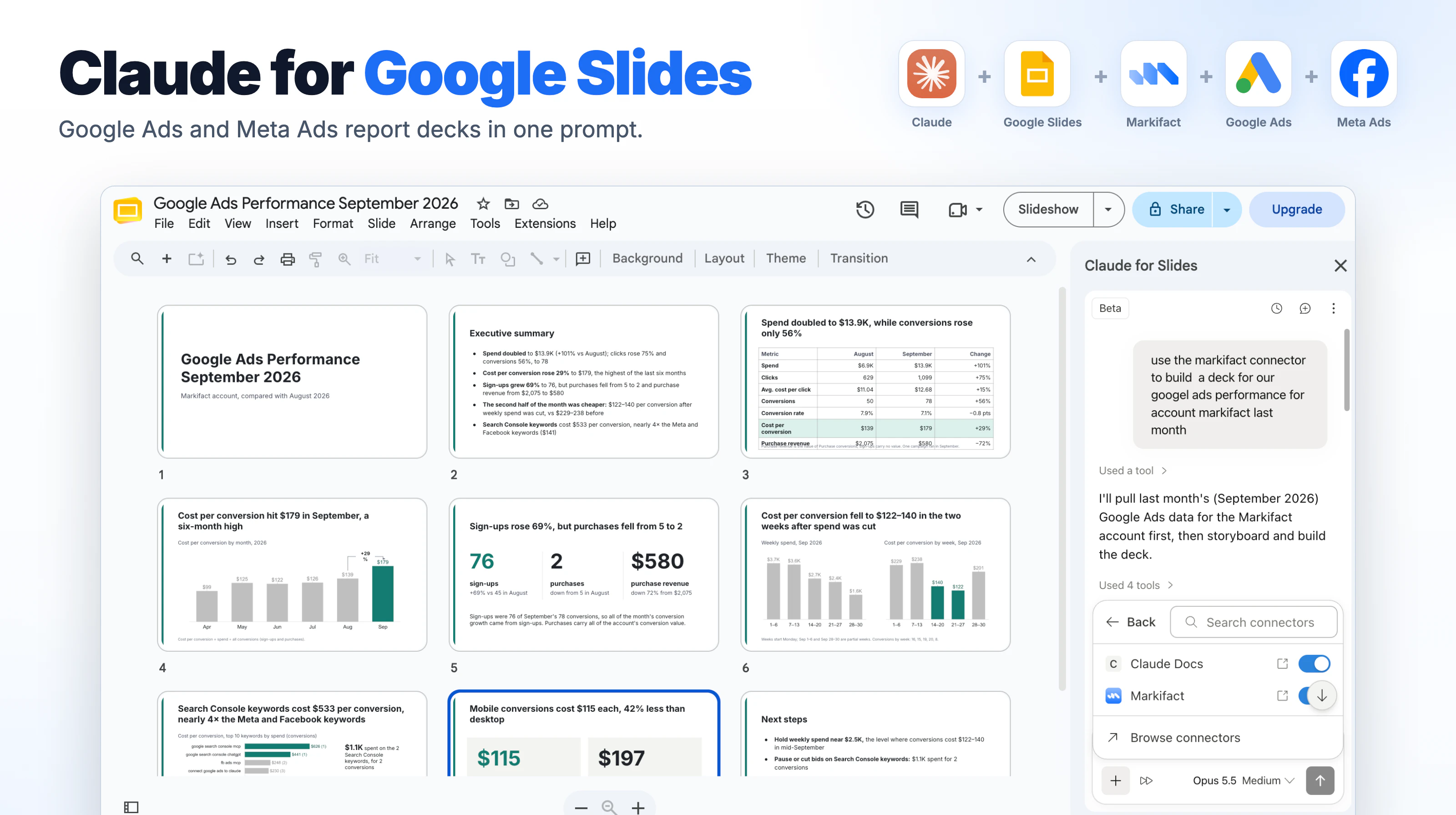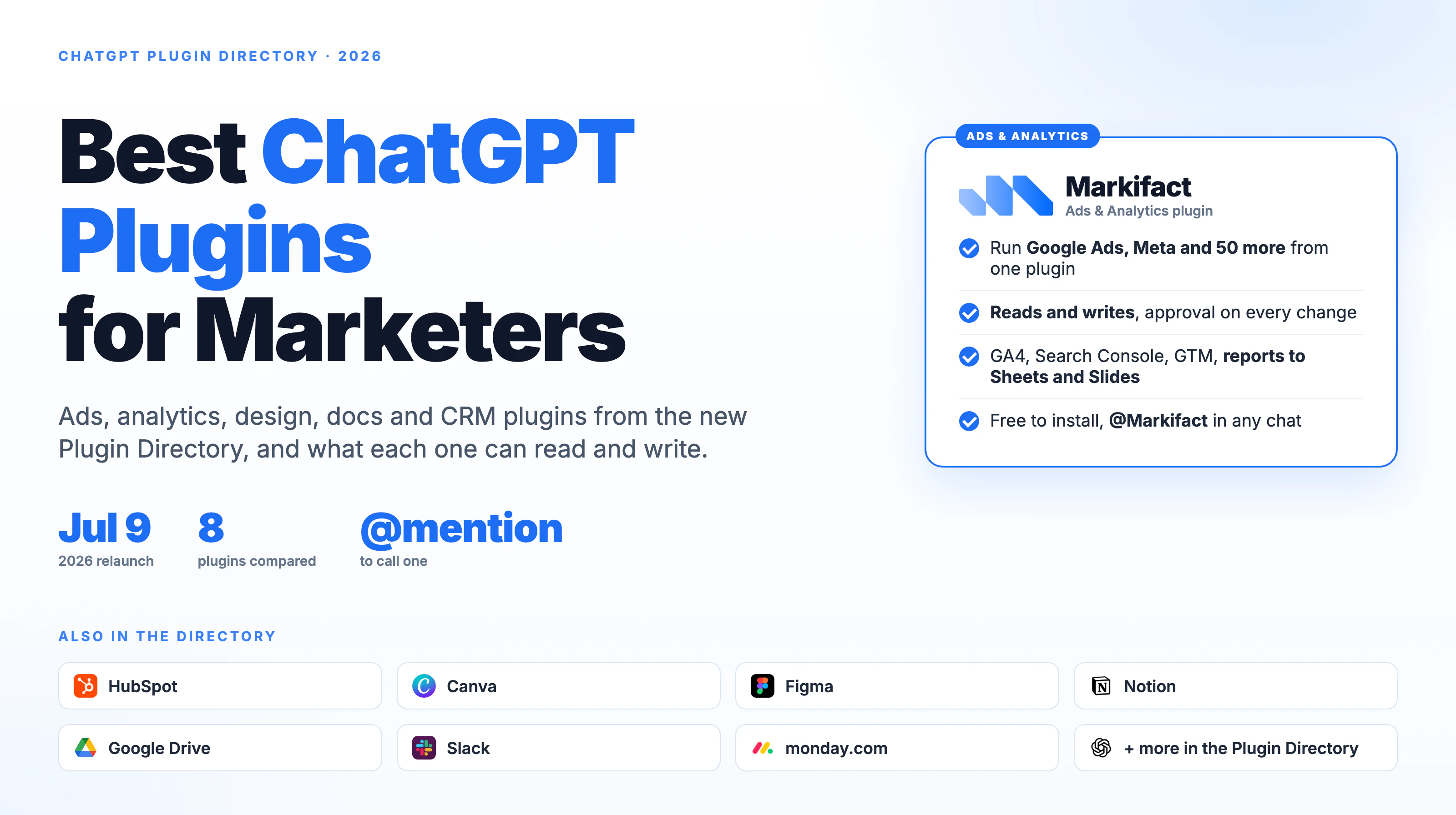

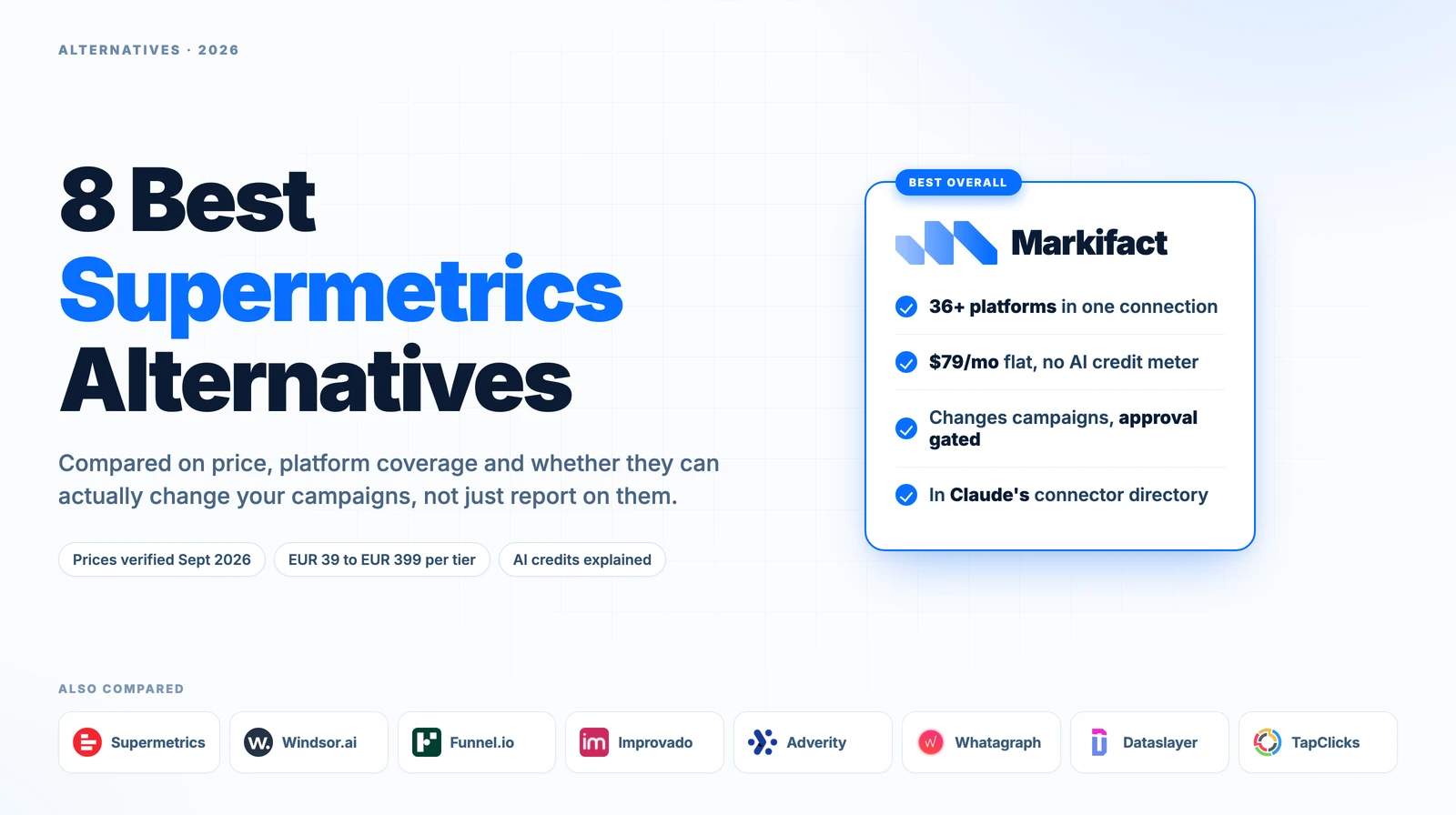
The best Supermetrics alternative in 2026 is Markifact, because the job most marketing teams are hiring these tools for has changed. You are no longer just piping ad data into a dashboard. You want to ask questions of your accounts in plain language and act on the answer, and you do not want the bill to grow every time you add a platform. Markifact covers 36+ platforms on one connection for $79 a month, with full reporting and approval-gated changes to your live campaigns.
This guide compares eight alternatives, with every price read from the vendor's own pricing page. Last verified: September 8, 2026.
The short answer
| If you want to | Use |
|---|---|
| Ask questions and make approved changes across all your ad platforms | Markifact |
| Pipe data into a warehouse at enterprise scale | Funnel.io or Improvado |
| Build client-facing reports and dashboards | Whatagraph or TapClicks |
| Spend as little as possible on a basic connector | Dataslayer |
Why teams leave Supermetrics
Three things about how Supermetrics is priced drive most of the searching, and all three are visible on their own pricing page.
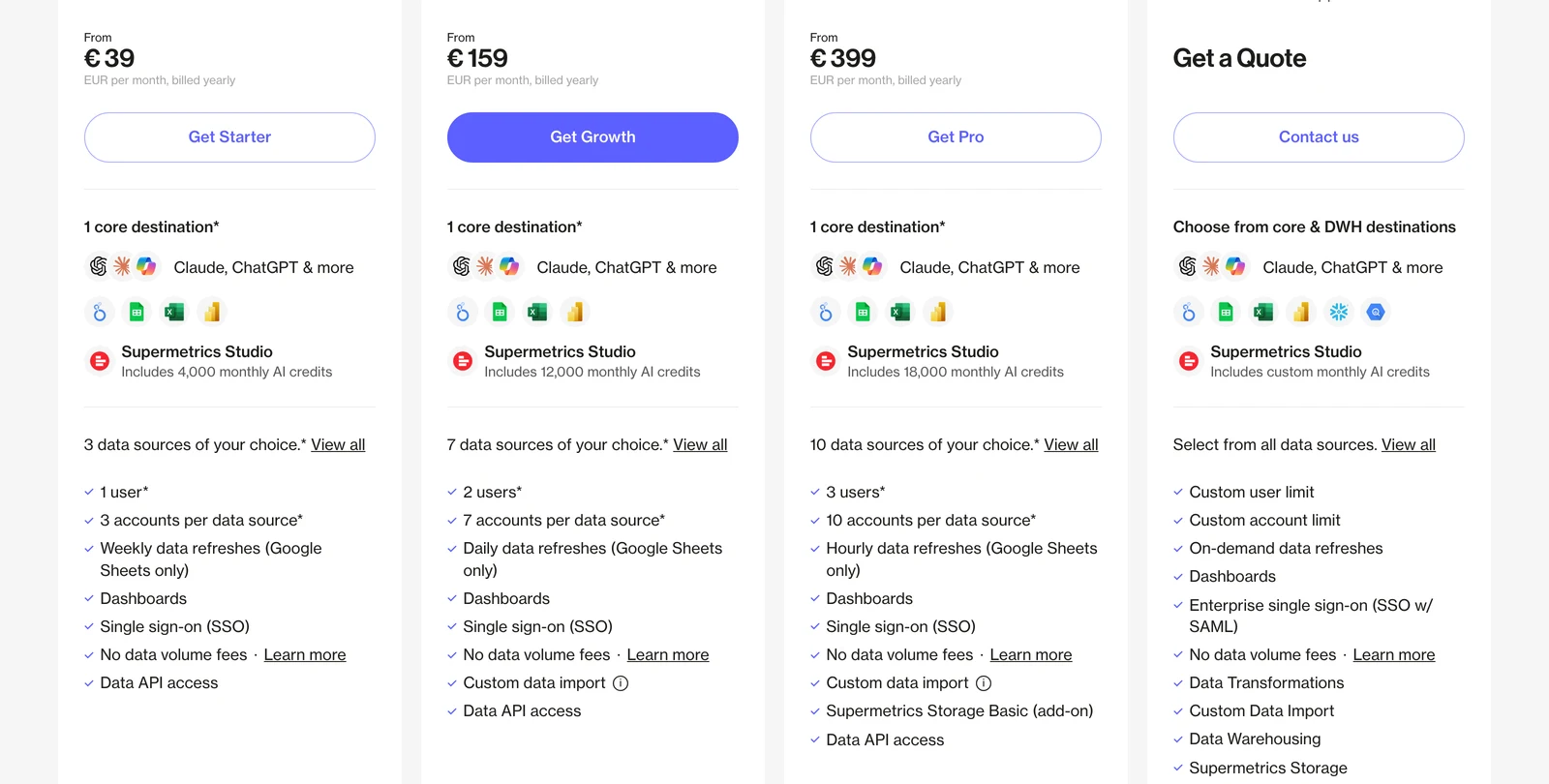
You pay by number of data sources. Starter is EUR 39 per month billed annually and covers three data sources. Growth is EUR 159 and covers seven. Pro is EUR 399 and covers ten. Run Google Ads, Meta, GA4, Search Console and TikTok and you are already at five sources, so you are on Growth. Add LinkedIn, Shopify and a CRM and you are on Pro at EUR 399.
Each plan includes one core destination. You choose one from ChatGPT, Claude, Looker Studio, Google Sheets, Excel or Power BI. Wanting both a dashboard and an AI connector means choosing between them, or paying more.
AI usage is metered. Plans carry 4,000 monthly AI credits on Starter, 12,000 on Growth and 18,000 on Pro.
The pattern is that the pricing punishes breadth, and the modern marketing stack is nothing but breadth.

For what it is worth, the top-ranking discussion of this question is a Reddit r/PPC thread where the most upvoted reply says "Dataslayer is genuinely good and way cheaper than Supermetrics." That is one practitioner's view, but the theme is consistent.

The eight alternatives at a glance
| Tool | Best for | Platforms included | Changes campaigns | Entry price |
|---|---|---|---|---|
| Markifact | Working in AI across every ad platform | 36+, unlimited ad accounts | Yes, approval-gated | $79/mo |
| Supermetrics | Staying where you are | 3, 7 or 10 by tier | Yes, created paused | EUR 39/mo annual |
| Funnel.io | Enterprise warehouse pipelines | 117 to 600+ by tier | Not published | From $300/mo annual |
| Improvado | Enterprise data governance | 1,000+ sources, enterprise scale | Not published | Free tier, MCP Only $100/mo |
| Windsor.ai | One vendor for dashboards plus AI reads | 1 to 14 by tier, 350+ available | Not published | Free, then $19/mo annual |
| Whatagraph | Client-facing report production | Credit based, from 50 | No | From EUR 699/mo annual |
| Dataslayer | The cheapest possible connector | 3, 7 or 10 by tier | No | Free, then from EUR 20/mo annual |
| Adverity | Enterprise governance and procurement | Not published | Not published | Quote only |
| TapClicks | Agencies wanting a full reporting suite | Large catalogue, counts vary by page | No | Quote only |
One thing worth noticing before the detail: almost every tool below has added AI or MCP access in the last year. The difference is whether it is the product or an attachment. For everyone except Markifact, MCP sits on top of a data pipeline you are still paying for by the source.
1. Markifact: the best Supermetrics alternative for most teams
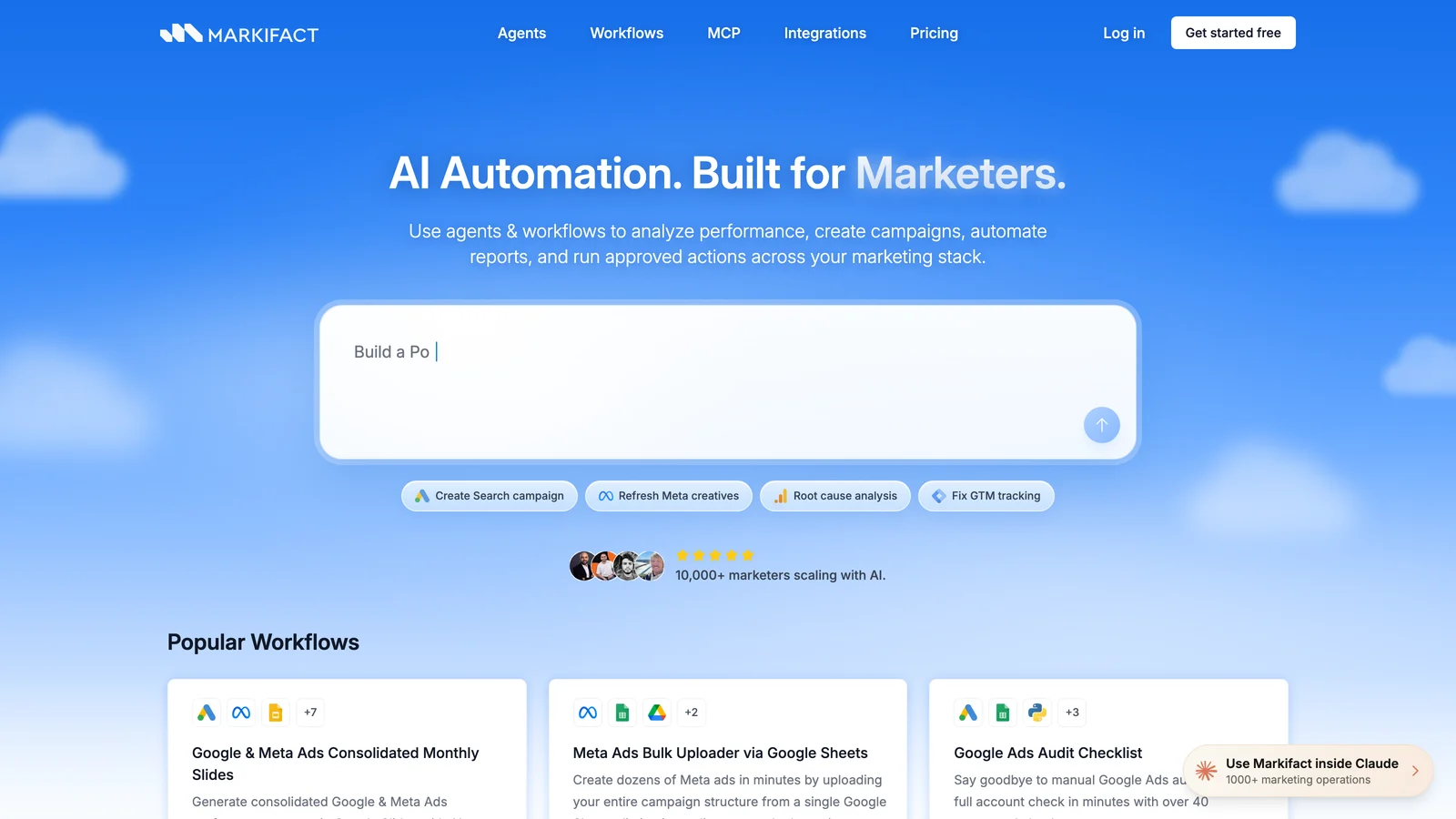
Markifact is an MCP server built for marketing, which means your AI assistant talks to your ad accounts directly. There is no pipeline to configure, no destination to pick and no dashboard to maintain. You open Claude or ChatGPT and ask.
Every platform is included. One connection covers more than 36 platforms: Google Ads, Meta Ads, TikTok, LinkedIn, Pinterest, Snapchat, Amazon Ads, GA4, Search Console, Google Tag Manager, Klaviyo, Shopify, Sheets, Slides and Docs, with the full list on the MCP hub. There is no per-source ladder and no cap on ad accounts. Adding your sixth or your sixteenth platform does not move you to a higher tier, which is the single biggest structural difference from everything else in this guide.
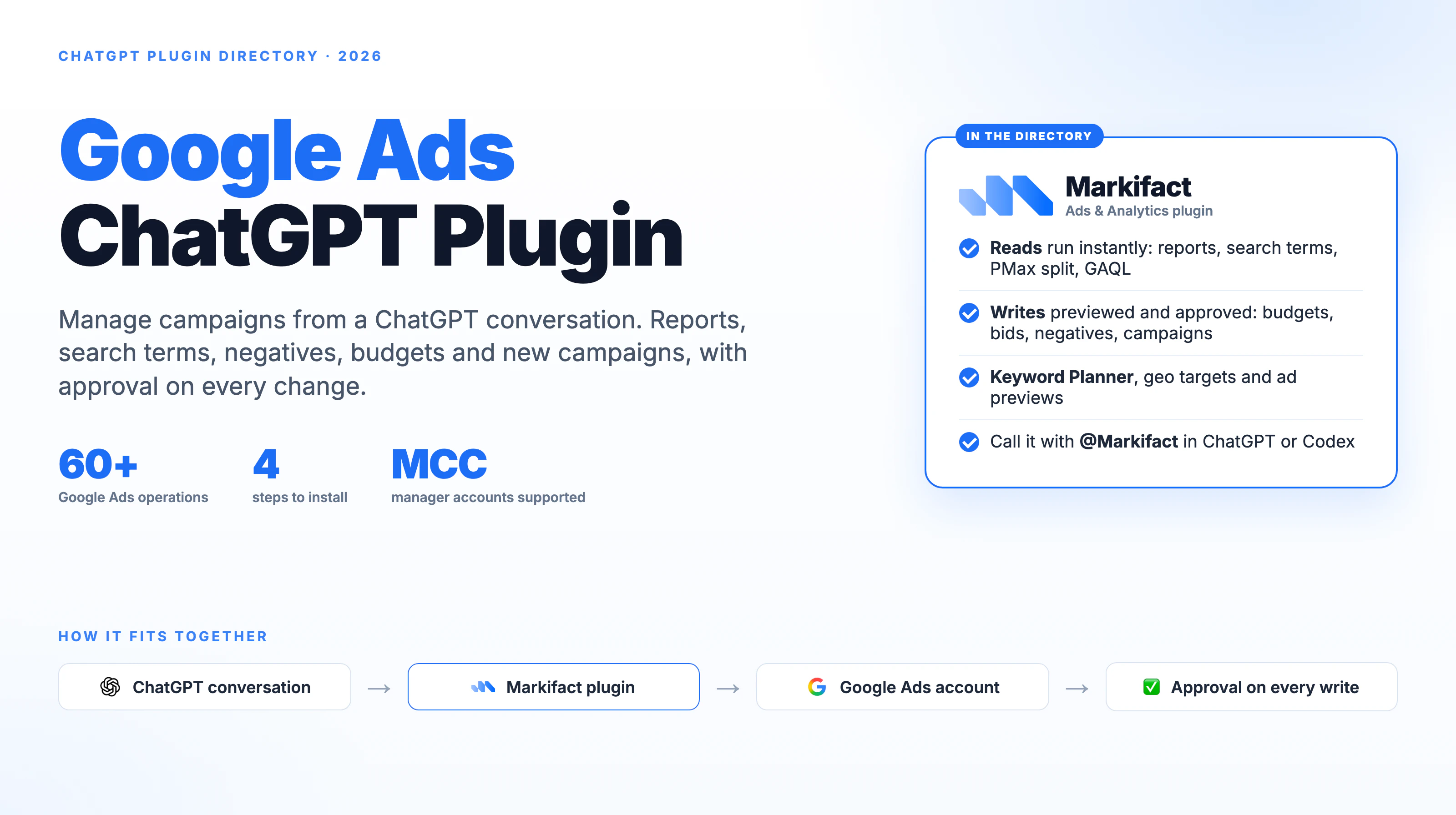
It changes things, safely. Reads run instantly: pull a cross-account report, compare periods, break performance down by placement, device or audience, review search terms, or ask why CPA moved. Writes are approval-gated. The assistant prepares the exact change, shows you the operation and the values, and nothing reaches the platform until you approve it. That is stronger than creating a campaign in a paused state, because the change does not exist on the ad platform at all until you say so. Operations such as gads_get_report, gads_add_negative_keywords_to_campaigns and meta_ads_create_ad_creative are examples from a much larger catalogue.
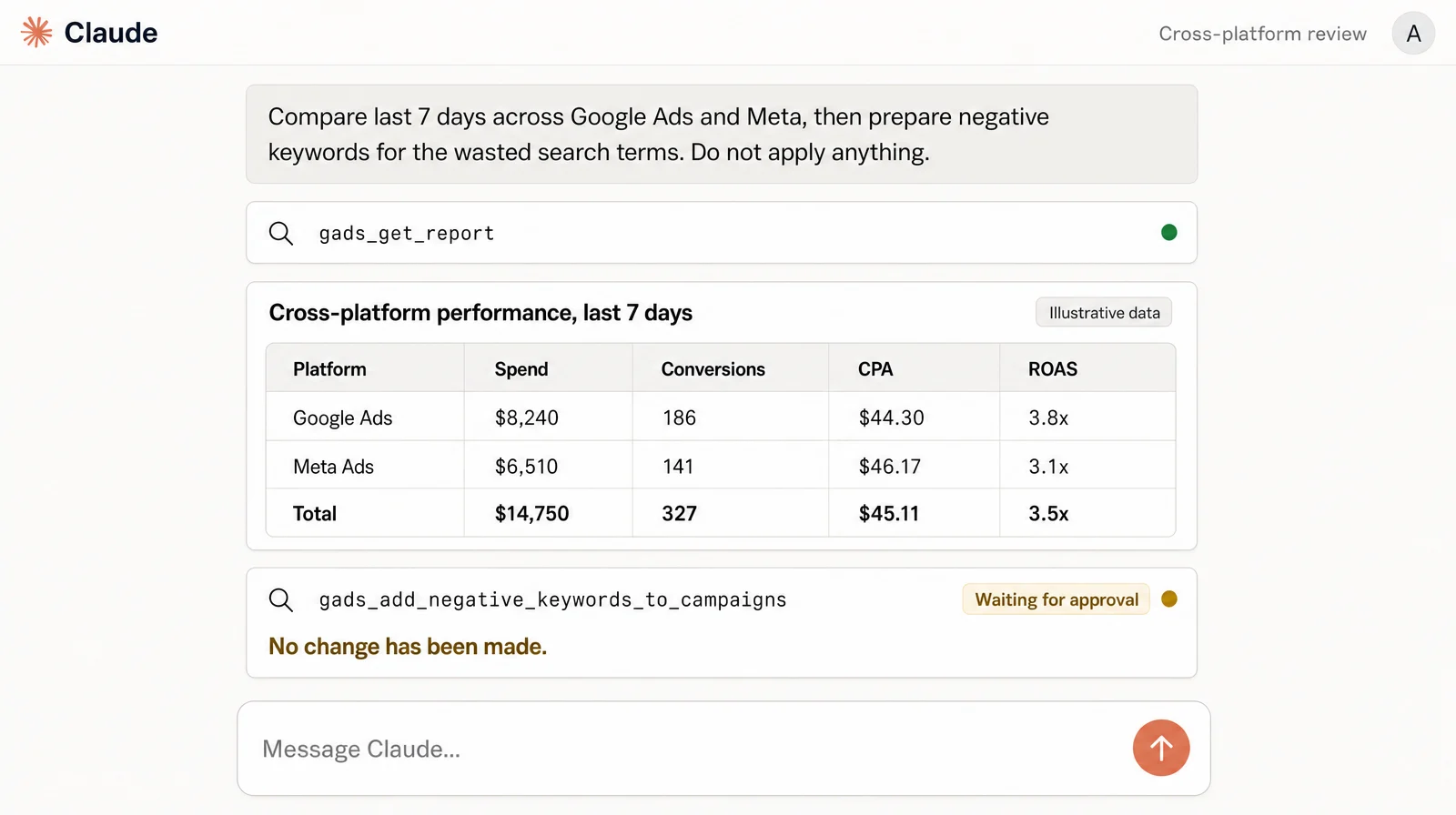
Setup is a directory install. Markifact is listed in Claude's connector directory, so there is no URL to paste and no developer token to request. The same connection works in ChatGPT, Claude Code, Cursor and any MCP-compatible client.

Pricing is flat. Pro is $79 per month with one seat. Team is $249 per month with 10 to 50 seats, shared workspace, 30-day execution logs and API access. Annual billing gives two months free, and a Managed plan covers done-for-you setup.
Against Supermetrics the comparison is straightforward. A team running five ad platforms plus GA4, Search Console and a CRM needs the EUR 399 Pro tier to cover eight sources, gets one destination, and is metered on AI credits. The same team is on Markifact Pro at $79 with every platform included.
Best for: marketers and agencies who run several platforms and want analysis and execution in one place rather than another dashboard.
Where it is not the answer: Markifact does not push data into Looker Studio, Power BI or a warehouse on a schedule. If that is your requirement, pair it with one of the pipeline tools below.
2. Funnel.io
The closest like-for-like replacement at the top of the market. Starter begins at $300 per month billed annually with 117 connectors and 13 destinations, Business at $600 with 579 connectors and 46 destinations, and Enterprise passes 600 connectors and adds SSO.
Considerably broader than Supermetrics, and considerably more expensive at entry. AI or MCP access is not published on their pricing page.
Best for: large teams whose problem is connector coverage and data guarantees rather than cost.
3. Improvado
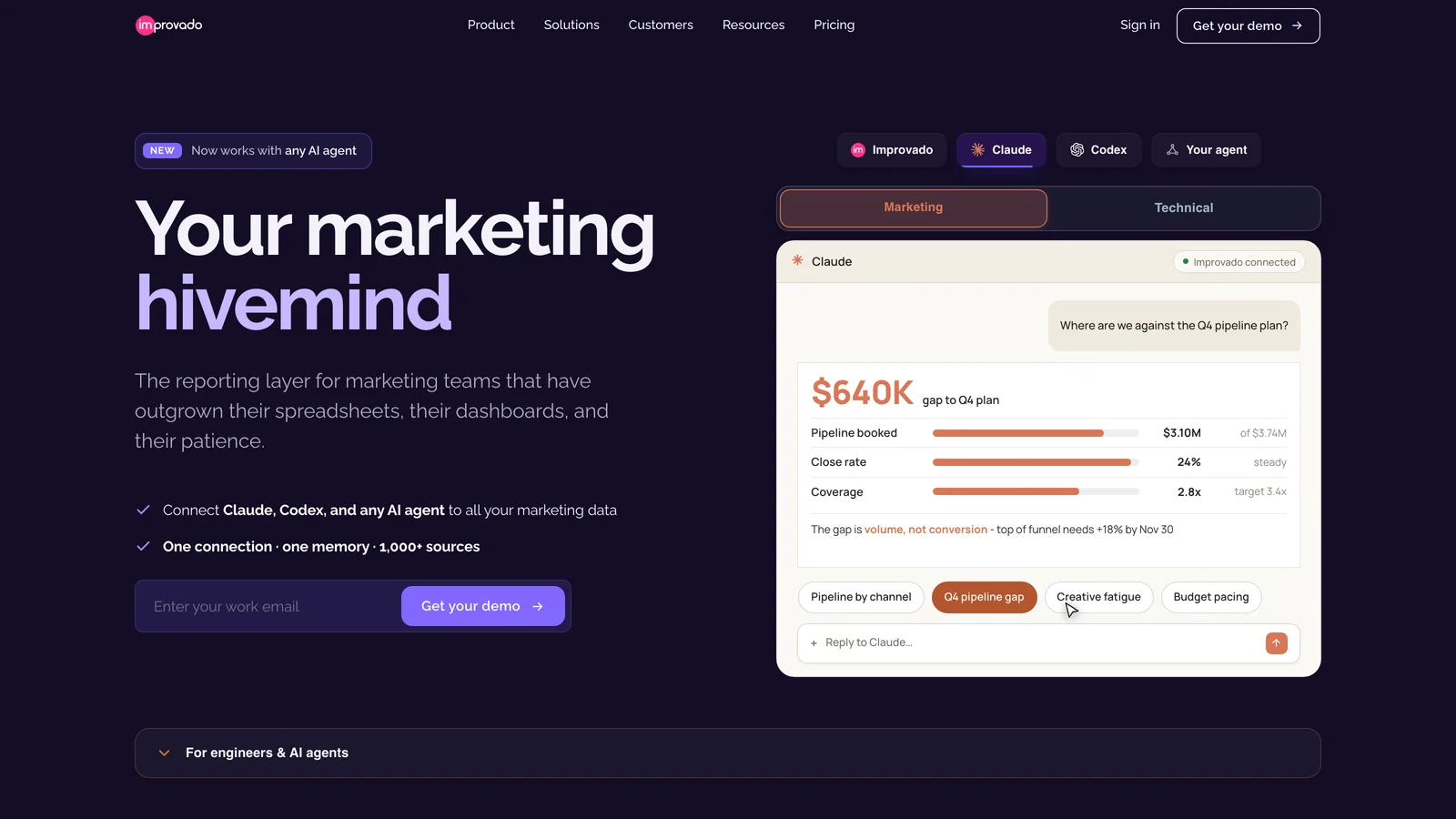
An enterprise platform whose own pricing calculator uses examples like $25M in annual ad spend and $80M in tracked revenue, which tells you who it is built for. It now leads with AI agent access, advertising "one connection, one memory, 1,000+ sources" and support for Claude, Codex and any AI agent.
It publishes a plan called MCP Only at $100 per month with 2M rows a year and 300 MCP actions a week, plus a free tier with 50 MCP actions a week. Advanced and Enterprise are custom and scale to 4,000 and 12,000 MCP actions weekly. Metering AI usage by actions per week is the same shape of constraint Supermetrics applies with credits.
Best for: large marketing organisations with governance requirements and a procurement process.
4. Windsor.ai
A data connector business that added an MCP server, and it includes "access to Windsor MCP for AI analysis" on every plan including the free one. Paid plans run $19, $99, $249 and $499 per month billed annually, gated by data sources at 3, 7, 10 and 14 and by accounts at 75, 75, 200 and 500. Enterprise reaches 200 data sources. More than 350 platforms are available, but your plan decides how many you may connect.
The emphasis is analysis rather than execution, and the per-source ladder is the same model people leave Supermetrics to escape.
Best for: teams that want one vendor for both dashboards and AI reads, and do not need to make changes.
5. Whatagraph

Reporting and dashboards rather than a pipeline. Max starts at EUR 699 per month billed annually, using credits rather than fixed source counts at one credit per source, starting from 50. Prime is custom and adds premium integrations, a custom report domain and BigQuery and Looker Studio transfer. Unlimited users and reports on both. The product now advertises MCP on its semantic layer, with AI agents listed as coming soon.
Best for: agencies whose real cost is the hours spent producing recurring client reports.
If you are choosing between reporting tools rather than pipelines, we compared them in our AgencyAnalytics alternatives guide.
6. Dataslayer
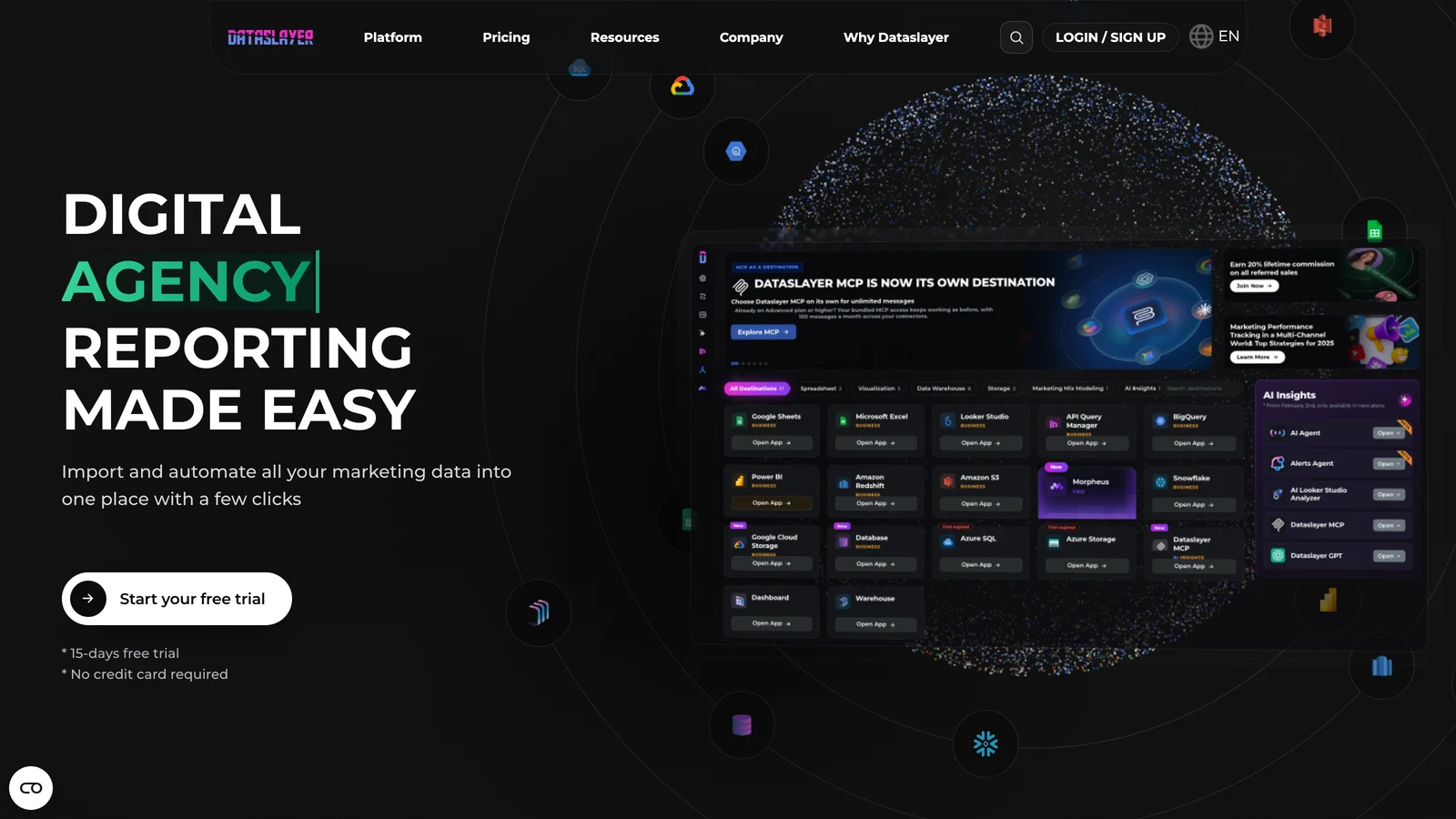
The cheapest credible option in this guide, with a free tier and paid plans from EUR 20 per month billed annually. Connectors run 3, 7 and 10 across Starter, Advanced and Pro, mirroring the Supermetrics ladder at a fraction of the price. Core destinations, Sheets, Excel, Looker Studio and Power BI, are unlimited rows, while warehouse destinations are metered from 5,000 rows a month on Starter to 2M on Pro.
Their product now treats Dataslayer MCP as its own destination, with bundled message allowances on higher plans. Note that their pricing page rendered all three paid tiers at the same price on the verification date, so confirm the tier before buying.
Best for: teams whose only objection to Supermetrics is the invoice.
7. Adverity

No published prices at all. Their position is that "because every customer is different we don't stick to rigid pricing plans." A governance-heavy enterprise integration platform with transformation and monitoring that sends data to any BI tool.
Best for: enterprises with a procurement process, not teams who want to start this afternoon.
8. TapClicks
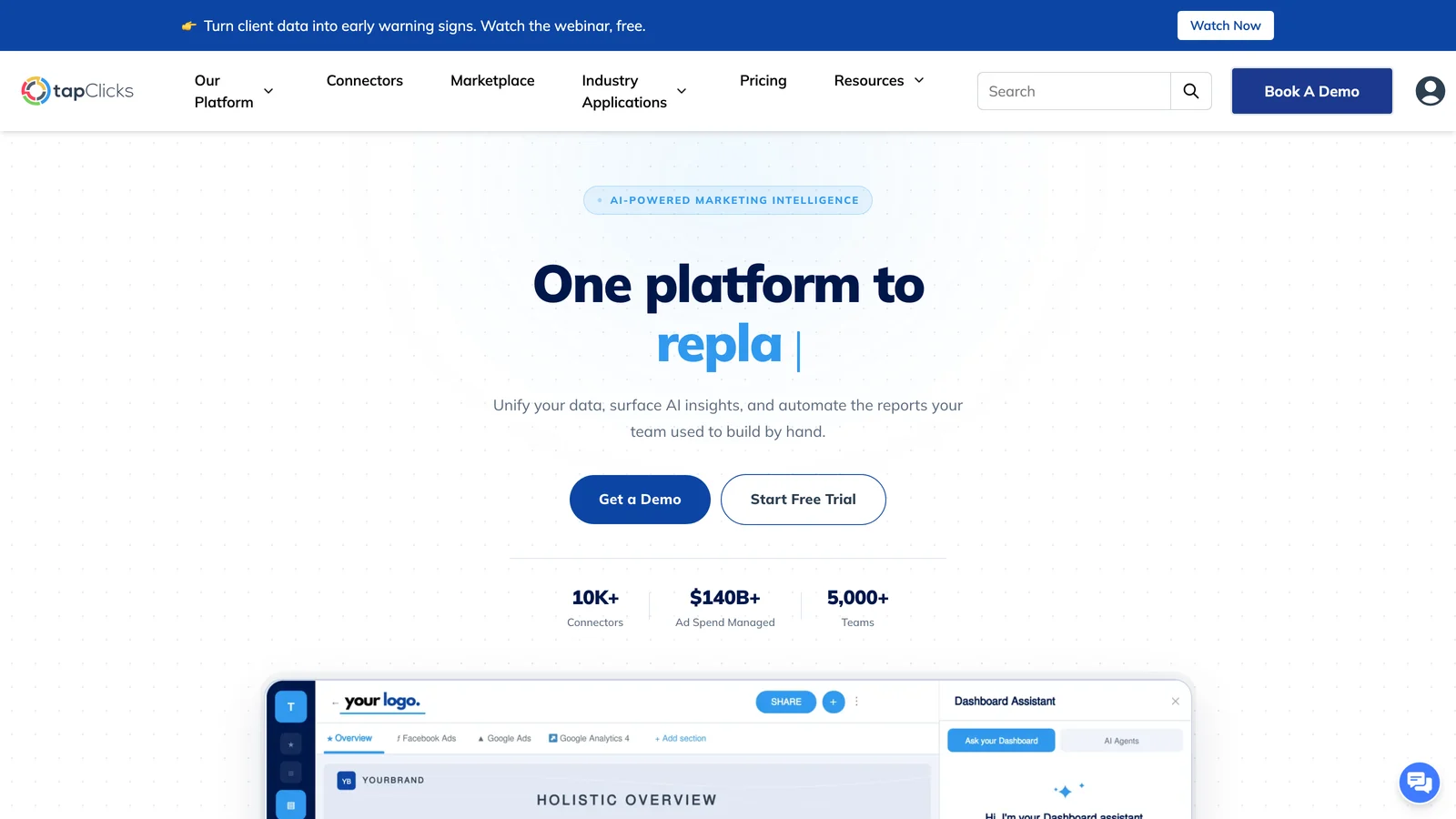
Quote-only across four tiers from SmartStory to SmartSuite. A large connector catalogue arrives at SmartReports, though the count differs between their homepage and their pricing page, so confirm it for your plan. AI appears as SmartSlides deck generation and, at SmartSuite, custom AI agents.
Best for: agencies buying reporting, dashboards and client portals as a single package.
What about Supermetrics' own Claude connector?
Worth addressing directly, because most alternatives lists have not caught up with it. Supermetrics states on its connector page that you get "full read and write access", that Claude can create Search, Shopping and Performance Max campaigns, modify bids, pause ad groups and add negative keywords, and that new campaigns are "created paused so you can review."
Those are their claims rather than our test results, and they make Supermetrics a real participant in this category. The constraints are the ones already described: your plan buys a fixed number of data sources, exactly one core destination, and a monthly allowance of AI credits. If the reason you are reading this page is that the source ladder has become expensive, the Claude connector does not fix it, because it sits on top of the same pricing.
How to choose
Five questions settle it faster than any feature table.
- How many platforms do you run? This is the biggest cost driver in the market. Count honestly, including what you will add this year. Above four or five, per-source pricing gets expensive fast and flat pricing wins.
- Do you need to change things, or only read? Most tools here are read-only. Markifact and Supermetrics' connector can act, and their safety models differ.
- What is the deliverable? A dashboard someone opens, a report you send, or an answer in a chat window.
- How many destinations? One core destination per plan is a real constraint if you want both a dashboard and an AI connector.
- Who is doing the work? Warehouse pipelines assume a data person. An MCP connector assumes a marketer.
Most teams end up in one of two places: a pipeline tool for scheduled dashboards, or Markifact for analysis and execution. Plenty run both, and the combined cost is often lower than pushing a single source-priced plan up a tier.
Frequently asked questions
What is the best Supermetrics alternative?
Markifact, for most marketing teams. It covers 36+ platforms on one connection with no per-source pricing, works inside Claude and ChatGPT, and can make approval-gated changes to live campaigns rather than only reporting on them. For enterprise warehouse pipelines, Funnel.io and Improvado are the stronger choices.
What is the cheapest Supermetrics alternative?
Dataslayer, with a free tier and paid plans from EUR 20 per month billed annually, is the cheapest connector verified here. Windsor.ai and Improvado also publish free tiers. If you run several platforms, compare total cost rather than entry price, since per-source pricing rises quickly and Markifact at $79 includes every platform.
Which Supermetrics alternatives can change campaigns, not just report?
Markifact and Supermetrics' own Claude connector, based on published vendor claims. Markifact holds every write for explicit approval before it reaches the ad platform, so the change does not exist on the platform until you approve it. Everything else in this guide is read-only or does not publish write capability.
Does Supermetrics have an MCP server or Claude connector?
Supermetrics offers Claude and ChatGPT as core destinations and claims full read and write access to Google Ads from Claude, with new campaigns created paused. Each plan includes one core destination and a monthly allowance of AI credits, so the source and credit limits still apply.
Is there a Supermetrics alternative with unlimited data sources?
Markifact includes 36+ platforms and unlimited ad accounts on every plan, so adding platforms does not change the price. Most alternatives here, including Supermetrics, Windsor.ai and Dataslayer, gate data sources by tier.
Can I replace Supermetrics for Looker Studio reporting?
Yes, that is the most substitutable use case, and Funnel.io, Dataslayer and Whatagraph all target it. An MCP connector such as Markifact does not push data into dashboards, so if a Looker Studio report is the deliverable, pair the two.
How much does Markifact cost compared with Supermetrics?
Markifact Pro is $79 per month with every platform included and unlimited ad accounts. Supermetrics covers three data sources at EUR 39, seven at EUR 159 and ten at EUR 399, each with one core destination. A team running eight platforms pays EUR 399 at Supermetrics and $79 at Markifact.